Food Trailer Health Inspection Checklist: What Inspectors Actually Look For
Food Trailer Health Inspection Checklist: What Inspectors Actually Look For
For most new mobile entrepreneurs, the day of the initial health department walkthrough is more nerve-wracking than the grand opening. It is the final gatekeeper between your investment and your first dollar of revenue. Understanding a comprehensive food trailer health inspection checklist is not just about avoiding fines; it is about ensuring that your custom build meets the rigorous safety standards required for nationwide operation.
Thinking about your own food trailer?
Get a free quoteAt Food Trailer Pros, based in Texas, we see many operators struggle because they purchased a converted utility trailer or a DIY project that lacks the fundamental engineering required by health departments. Whether you are operating in Austin or shipping a unit to Florida, the core principles of the inspection remain remarkably consistent. This guide breaks down the technical specifics—from BTU outputs to gallon capacities—that inspectors prioritize.
Water Systems: The Foundation of Compliance
The most common reason for an immediate fail during an inspection relates to the water system. A mobile food unit must function as a self-contained environment with the same sanitary capabilities as a brick-and-mortar restaurant. Your food trailer health inspection checklist must start here.
Potable and Waste Water Ratios
Inspectors look for specific capacities. Generally, your fresh water tank must be a minimum of 30 gallons, though high-volume units often require 40 to 50 gallons. The critical rule is the 15% margin: your gray water (waste) tank must be at least 15% larger than your fresh water supply to prevent overflow. If you have a 40-gallon fresh tank, your waste tank must be at least 46 gallons. All tanks must be made of food-grade plastic or stainless steel.
Hot Water Delivery
You must demonstrate that your water heater can maintain a consistent temperature of at least 100°F (38°C) for handwashing and 110°F to 120°F for warewashing. In our custom builds, we utilize heavy-duty electric or propane water heaters that provide immediate recovery. If the inspector turns on the tap and the water is lukewarm, the inspection ends immediately.
The Three-Compartment Sink and Handwashing Protocol
Plumbing layout is a non-negotiable part of any health department requirement. Inspectors check for the physical separation of tasks. You cannot wash your hands in the same sink used for rinsing lettuce or cleaning pans.
- The Three-Compartment Sink: Each basin must be large enough to submerge your largest piece of equipment (e.g., a 12-inch sauté pan or a full-sized hotel pan). These basins are used for the Wash-Rinse-Sanitize process.
- The Dedicated Hand Sink: This must be a separate basin equipped with hot and cold running water, a soap dispenser, and a single-use paper towel holder. It must be easily accessible to the cook line.
- Splash Guards: If your hand sink is within 12 to 18 inches of a food preparation surface or the warewashing sink, a stainless steel splash guard is usually required to prevent cross-contamination.
Commercial-Grade Equipment and NSF Standards
A major red flag for any inspector is the presence of residential-grade appliances. A refrigerator purchased from a big-box home improvement store is not designed to hold a steady 41°F in a 100-degree Texas summer. Your checklist must verify that every piece of cooking and cooling equipment is NSF (National Sanitation Foundation) or ANSI certified.
Refrigeration Metrics
Inspectors will bring their own calibrated thermometers to check your reach-ins. Your refrigeration must hold food at or below 41°F. If you are doing high-volume prep, the inspector will look for how quickly your unit recovers its temperature after the door is opened. For hot holding, equipment must maintain a consistent 135°F or higher.
Ventilation and Fire Suppression
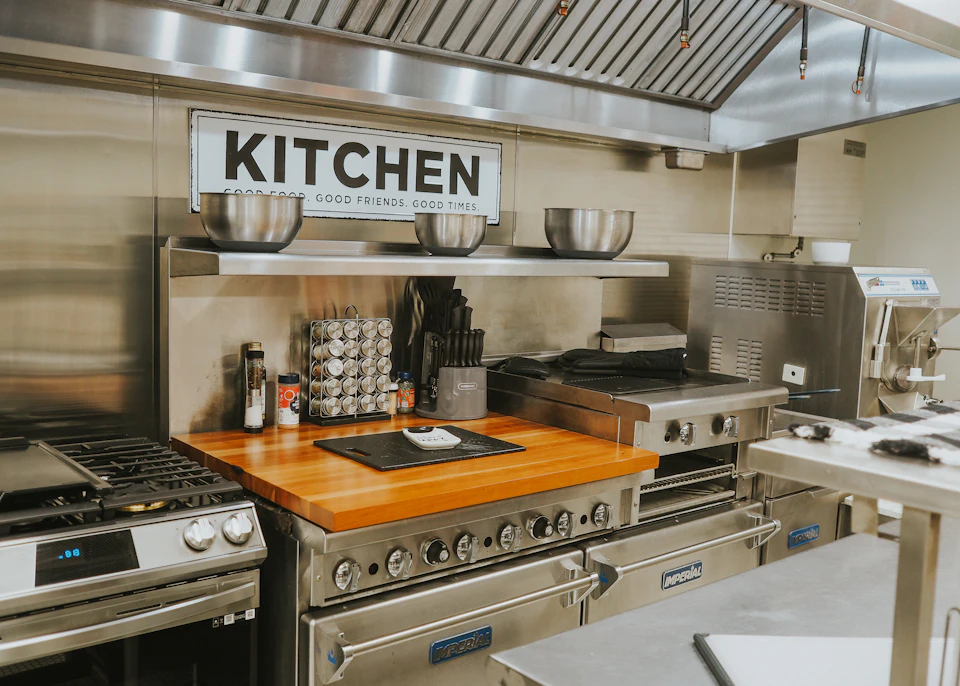
If your menu involves grease-laden vapors (frying, grilling, searing), a professional Type 1 hood system is mandatory. Inspectors check for the "overhang"—the hood must extend 6 inches beyond the cooking surface on all sides. Furthermore, the fire suppression system (like an Ansul R-102) must be tagged and certified by a licensed technician. This is a common bottleneck in lead times, so ensure your builder integrates this early.
Interior Surfaces and Construction Integrity
The interior of your food trailer must be "smooth, non-absorbent, and easily cleanable." This is the phrasing used in nearly every health code across the United States. During your food trailer health inspection, the official will examine the seams where the walls meet the floor.
- Wall and Ceiling Liners: We recommend 040" white aluminum or stainless steel. Raw wood, porous ceiling tiles, or exposed insulation are automatic failures.
- Flooring: Commercial-grade vinyl (coved 4 inches up the wall) or diamond plate aluminum are standard. The goal is to ensure that a spill can be mopped up without liquid seeping into the subfloor.
- Lighting: All light fixtures must be shielded or shatterproof. This prevents glass shards from entering food in the event of a bulb exploding.
Administrative Prep and Documentation
Passing the physical inspection is only half the battle. You must also have your paperwork in order. Many jurisdictions require a "Commissary Letter of Agreement." Since most trailers cannot handle massive bulk prep or grease disposal on-site, you must prove you have a home base for these tasks.
The Inspector’s Paperwork Checklist:
- Certified Food Manager Certificate: At least one person on-site (often the owner) must hold a current manager-level food safety certification.
- Standard Operating Procedures (SOPs): Documentation on how you sanitize surfaces and monitor temperatures.
- The Route/Location List: Some counties require a list of where you intend to park, ensuring you have access to a restroom within 500 feet of the trailer.
Managing Your Investment with Food Trailer Pros
Navigating these regulations can be daunting for first-time owners. At Food Trailer Pros, we specialize in high-quality, compliant custom builds that are engineered to pass inspections nationwide. We understand that capital is a primary concern for new businesses, which is why we offer flexible financing options, including Buy Here Pay Here and in-house financing programs, to help you get on the road without the traditional bank headaches.
Our current lead times are optimized to get you from design to inspection in weeks, not months. By choosing a manufacturer that understands the specific nuances of Texas and national health codes, you eliminate the risk of costly retrofits.
Conclusion
A food trailer health inspection checklist is your roadmap to professional legitimacy. By focusing on high-quality water systems, NSF-certified equipment, and non-porous interior surfaces, you demonstrate to the health department that you are a serious operator committed to public safety. When you are ready to build a unit that meets these standards from the floor up, contact the experts at Food Trailer Pros to discuss your vision and our Texas-made quality.
Food Trailer Pros
Custom food trailer manufacturer based in Texas. 500+ trailers delivered nationwide. In-house financing, full equipment customization, and nationwide delivery.
Ready to build your Food Trailer?
Let's make it happen. Get a free quote from Food Trailer Pros today.
Table of contents
Get food trailer tips in your inbox
Join our newsletter for the latest guides on permits, financing, equipment, and growing your mobile food business.
No spam. Unsubscribe anytime.